


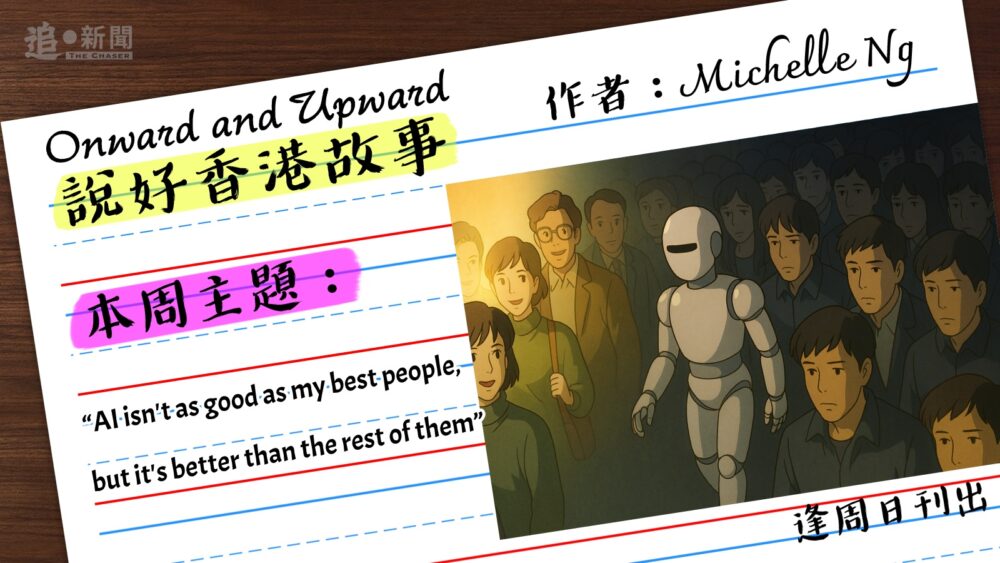
Earlier this week, the YouTube channel Info-Tech Research Group interviewed Deloitte’s managing director and chief futurist Mike Bechtel, who recounted a conversation with a business owner that should alarm every white-collar worker about their career prospects in the AI era.
When ChatGPT first came out in November 2022, Bechtel showed the business owner, who founded a hydraulics company, that AI could write verses in the style of Shakespeare convincing enough to trick Shakespearean scholars. “We do not make poetry,” came his curt reply. It took merely a year for his attitude towards AI to undergo a sea change; he was now using AI as a sparring partner when wrestling with strategic business questions.
“AI is not as good as my best people, but between you and me, it’s better than the rest of them,” Bechtel quoted him as saying.
Since ChatGPT came out, I’ve had the chance to inspire students on another front: letting them bear witness to my struggles to remain relevant as a writer and writing coach at a time when a machine can spew out passable prose in seconds. The day will come when, they, too, will have to brave through the same struggle in their fields; I may then serve as one of their reference points.
The business owner’s 180-degree shift in his attitude towards AI will certainly be a reference point for us all, for it captures how employers and clients see us. We are now either “best people,” those who can do what AI isn’t yet good at, or we are “the rest,” workers whose skill levels are lower than AI’s and therefore aren’t attractive hires at all. It goes without saying that earning a place in the first group – and staying there – will be a constant battle requiring gifts, guts, and grit.
Below is a piece on AI that I recently wrote in class. I started out wanting to demonstrate the art of staging an argument to my student, but I ended up revealing something about the AI-dominated workplace he will face in the future.
Title: If you’re thinking without writing, you only think you’re thinking,
My English tutor, who is also a DIY nail enthusiast, has vowed to never let those nail robots at Target do her nails.
“I found the act of filing, shaping, and painting my nails incredibly stimulating,” she explained. “Letting robots do the job would deprive me of the chance to both challenge myself and have fun.”
My tutor’s stance against robot nail tech can shed light on whether students should use AI to write. Just as the process of working on her nails means more to her than having beautiful nails, the labor of writing essays – clarifying thoughts and putting them on paper – matters more than the final product. Such struggles students must undergo, if they want to develop the kind of high-order thinking that can give them an edge over AI in the workplace.
Silicon Valley investor Paul Graham supports this view of AI and writing. He quotes computer scientist Leslie Lamport’s quip “if you’re thinking without writing, you only think you’re thinking,” and predicts “in a couple decades there won’t be many people who can write.” This is a troubling prospect, for the ability to think clearly comes from the ability to write clearly. Graham likens writing in the AI age to working out at a gym. In preindustrial times, gyms didn’t exist because most people got all the exercise they needed through manual labour; in the AI era, even though writing can be easily outsourced to AI, we still need to learn and practise it to strengthen our brain muscles.
Graham’s warning about the future decline in cognitive abilities isn’t unfounded. Before the start of this academic year, New York University vice provost Clay Shirky expressed concern in the New York Times over this year’s freshmen, the first crop of young people who were exposed to AI for the majority of their high school years. An academic at another institution told him that when, in an effort to stamp out AI use, he forced students to write in-class exams instead of take-home essays, one of them complained bitterly “It’s like (you) want us to fail.”
Going forward, one solution may be to look backwards. One of my tutor’s favourite websites is the Internet Archive. There, she can gain free access to 47 million books, many of them published before the 1990s.
“Old books are markedly more well-written, perhaps because their authors worked at a time before internet distraction was a thing,” she speculated.
Now that the internet and the campuses are clogged with AI slop, it’s even more important to read old books and tune into the elegant voices from the past.
Michelle Ng
英國牛津大學畢業,前《蘋果日報》和《眾新聞》專欄作家,現在身在楓葉國,心繫中國大陸和香港。
個人網站: https://michellengwritings.com
多謝支持《追光者》,GoFundMe:
https://www.gofundme.com/f/pulse-hk-pulse-hk-crowdfunding-a-new-platform
Thank you for your support 🪔
🌟加入YouTube頻道會員支持《追新聞》運作🌟
https://www.youtube.com/channel/UC5l18oylJ8o7ihugk4F-3nw/join