


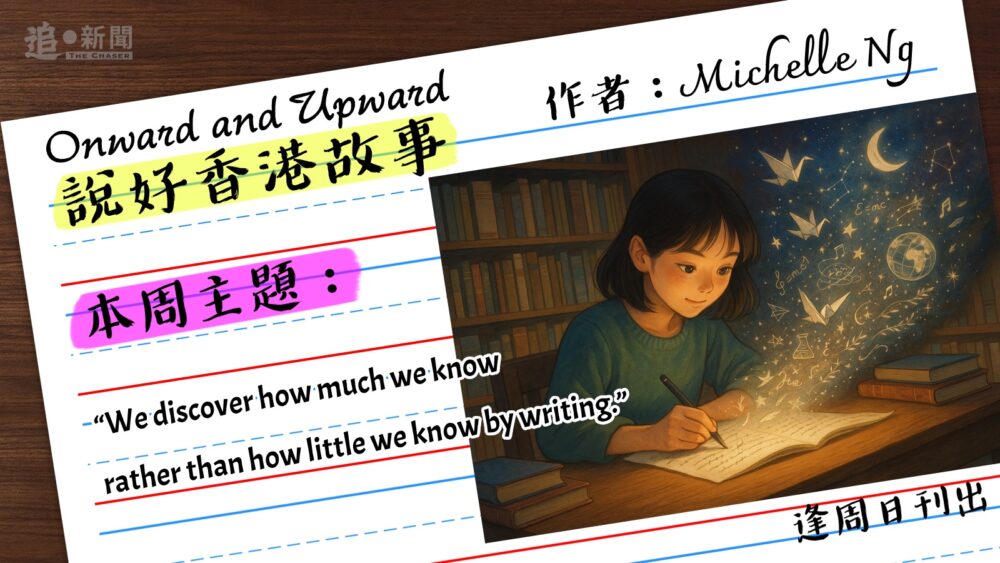
“We surprise ourselves by what we write. Writing is thinking, not thought recorded.”
“The text will teach us how it should be written if we learn how to listen to the evolving draft.”
“We discover how much we know rather than how little we know by writing.”
These declarations on writing, so profound in their simplicity, I first encountered as a senior school student in Donald Murray’s “Shoptalk: learning to write with writers.” The copy I read was borrowed from the Kowloon Public Library in Ho Man Tin. I seemed to be the only person interested in it, since it was always available whenever I wanted to read it yet again. Interestingly, now that I’m a writer, these truths have become so much part of my everyday reality that the freshness they once held for me has gone forever.
Because my eyes are constantly fixed on addressing my shortcomings and planning for the future – read this book, try out that writing style, work on such-and-such a project – I seldom look back to acknowledge the milestones I have reached. I was accidentally given the opportunity to do so a few weeks ago, when a student became visibly exasperated by the agony of writing, especially when he had me around as comparison. After the class, I wrote him the email below:
I hope you won’t feel discouraged in your efforts to write well. I suspect when we are writing together in class, and you see how, even though we are given the same amount of time, I’m always able to churn out a piece effortlessly while you seem forever stuck in the same paragraph – you may attribute your lagging to your lack of talent.
Nothing could be further from the truth. Below is a reference letter I wrote for my best friend in Oxford shortly after we graduated. At the time, she was applying for a research position and thought I could show her prospective employer another side of her. Over the years, the letter morphed into the most exact record I have of how tough Oxford was on me. Read it to discover what I experienced there.
After graduation, I continued sharpening my writing skills (eg I was a reporter for the Wall Street Journal for three years, which greatly improved my writing speed). Starting from 2017, I became an independent writer. But even at this point, I was mostly writing slowly and painfully. It was only a few years later, when I began tutoring and was forced to write quickly in class along with students, that I was able to gradually attain the degree of ease you now see. FYI, a few months ago, I hit 10,000 hours of teaching (there’s a theory that humans need to practise for 10,000 hours to become experts in their fields).
All this means that, on the assumption that you are as gifted as I am, you’ll have to work just as hard to reach the level you see me performing at in class. Of course, if you’re more talented you will need less time, but it will still take years, unless you’re a genius.
Anyway, I hope you’ll enjoy reading the reference letter below (to protect my friend’s privacy, I’ve blocked out information that can identify her). You have a really original mind. Don’t waste it!
The reference letter I wrote for my best friend in Oxford
Braque famously said of his relationship with Picasso that in the days when both were young and in the wonderful throes of breaking new ground with Cubism, ‘we were like two mountain climbers roped together’
It is in my capacity as a mountain climber who was once roped together with A – in my capacity as an Oxford arts graduate who, like A, arrived in Oxford determined to climb this summit known as thesis completion – that I’m writing this reference.
Granted, at first glance, it is not at all apparent how an arts (philosophy) postgraduate and a science one can be said to be ‘roped together.’ Yet this was precisely what happened, and precisely why I strongly believe A can, too, richly bless the lives of the members of XX College the way she has so richly blessed mine.
The following are some of the upclose ‘A in action’ snapshots I took while mountain climbing with her.
Almost always climbing a bit ahead of me (she arrived in Oxford one year earlier, plus she did a D.Phil while I only did a Masters), A demonstrated to me – before it was my turn to experience my share of major failures and minor triumphs – that the reality of research life is one where (to quote a Michael Polanyi passage we both loved and drew strength from):
“most of the time is spent in fruitless efforts, sustained by a fascination which will take beating after beating for months on end, and produce ever new outbursts of hope, each as fresh as the last so bitterly crushed the week or month before. Vague shapes of surmised truth suddenly take on the sharp outlines of certainty, only to dissolve again in the light of second thoughts or of further experimental observations. Yet from time to time, certain visions of truth, having made their appearance, continue to gain strength both by further reflection and additional evidence. These are the claims which may be accepted as final by the investigator. This is how scientific propositions normally come into existence.” (Michael Polanyi, Science, Faith and Society)
I’ve quoted from Polanyi at length because I want to show in detail some of the ‘shock’ A absorbed for me as my climbing leader: Because A was neither embarrassed nor afraid to share with me the ‘bad’ things that were happening to her work, I was able to psychologically prepare myself for the troubles that loomed ahead for me – when they finally hit, I wasn’t too surprised, and was able to get on with my work immediately.
Before I left Oxford, my thesis supervisor at Balliol, Dr. Timothy Endicott, told me that he ‘respected’ me because I ‘didn’t collapse’ even when work was sometimes so difficult. I am convinced that to a large degree, it was to A that I owed my resilience.
I am therefore also convinced that with her ability, generosity, and openness, A would be able to give members of XX College – especially the younger ones – straight talk on the rigours of research work and sound counsel on how to handle the emotional aspects of a thesis-grappling.
As a person, A is supremely capable of fighting for and then savouring what to me is the highest – the purest – form of happiness, the kind I suspect Marie Curie had in mind when, after reminiscing about the harsh conditions she endured for almost four years in her quest to isolate radium, she added ‘and yet it was in this miserable old shed that the happiest years of our lives (hers and Pierre Curie’s) were spent, entirely consecrated to work…entirely absorbed by the new realm that was opening before us…we lived in our single preoccupation as if in a dream.’
When I think about my Oxford days, I realize – to my surprise – not only how intensely happy I was, but also how my intense happiness was intensified because of my friendship with A , who, unlike many postgraduate students I came across, was intensely happy – intensely happy on her own when I discovered her.
I therefore expect A to be capable of intensifying the ‘pure’ type of happiness of those she’ll be meeting at XX College.
I also find endearing and moving A’s readiness to take on difficulties without a fuss. On the extra hurdles any foreigner must surmount in order to ‘make it’ in her adopted homeland, A likes to quote approvingly the admonishment Lewis Carroll’s Alice receives from the Queen: ‘Now here, it takes all the running you can do, to keep in the same place. If you want to get somewhere else, you must run at least twice as fast as that!’
Perhaps I should end this reference with an email A recently wrote to me. I am now venturing into the world of journalism, and have written to her asking whether fear will always accompany one in whatever one does. She replied”
“I am not able to give you a decisive answer, but what I understand is as long as we have immersed ourselves in a field long enough, we will feel less uneasy – this is not because uneasy situations don’t exist, but because we have learned to take things easy.”
Soothing words these were – A seems to instinctively know just what a friend needs.
Intelligence and wisdom are different things: one can be intelligent but not wise; one can be wise but not intelligent. A would have made a great friend even if she were only wise. But because she possesses both intelligence and wisdom, because I’ve been the ‘beneficiary’ of these qualities of hers and can thus picture how others may too be ‘beneficiaries,’ her Junior Research Fellowship application has my strongest support.
Michelle Ng
英國牛津大學畢業,前《蘋果日報》和《眾新聞》專欄作家,現在身在楓葉國,心繫中國大陸和香港。
聯絡方式: michelleng.coach@proton.me
個人網站: https://michellengwritings.com
多謝支持《追光者》,GoFundMe:
https://www.gofundme.com/f/pulse-hk-pulse-hk-crowdfunding-a-new-platform
Thank you for your support 🪔
🌟加入YouTube頻道會員支持《追新聞》運作🌟
https://www.youtube.com/channel/UC5l18oylJ8o7ihugk4F-3nw/join