


Call me an unconventional English writing tutor, but over the years, I’ve discovered one crucial benchmark that can reliably predict whether students will go on to achieve high marks and retain what I’ve taught them.
How much does laughter fill our sessions?
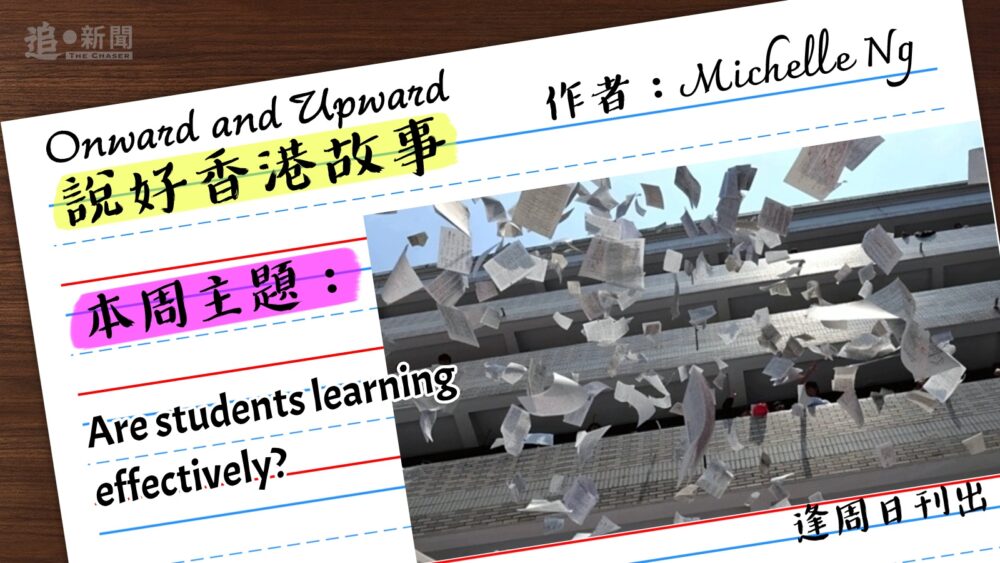
I have a theory about why this happens. Students absorb new knowledge best when they’re having fun, when they’re not aware that they’re learning. To see this, just look at what materializes when the opposite happens, when education is presented as an unpleasant process that its victims have to put up with for their own good. Over time, students will welcome learning as much as they welcome a root canal. The most extreme manifestation of this sentiment is this collective ritual some Mainland Chinese students participate in after completing the notoriously grueling University Entrance exam (高考). They gather outside their classrooms, hand-shred their textbooks, and toss the torn pieces from the balconies, cheering as they create a confetti-like cascade over the schoolyard below. I suspect most students leaving the exam hall would wish to do likewise, if only metaphorically. How else can one explain the curious fact that as soon as exams are over, students forget what they’ve spent months revising?
Earlier this week, I wrote the following piece in class with a student. Not only did it make her laugh. As I read out my work to her, I laughed out loud, too.
Essay topic:
A Strange Package – One morning, a mysterious package is delivered to your door. Describe what happens when you open it.
I was typing away in my home office when my phone buzzed and notified me that the DHL guy was only one stop away.
It must be the vintage hair curlers I had won in an auction on eBay, I thought, my mind filled with visions of the 1960s bouffant updos I had seen on social media which I could now replicate.
I waited for the parcel to hit my door. Once it did, I scrambled to unseal it.
It wasn’t the baby pink Velcro rollers I had been expecting. There was only a box covered in red silk, the type grandma used for storing her jewelry when she was still alive.
I unfastened the jade clasp. Inside was a strange object textured like pork rind, in the shape and size of an orange that had been cut in half. It had a familiar odor, but it took me a while to identify the smell – used sanitary napkins on heavy flow days (gross, I know).
I took a photo of the thing and uploaded it to ChatGPT. What is this, I asked.
Its medical name was Zi He Che, “purple river car” in Chinese, dried human placenta in actual fact. It’s a type of Chinese medicine that, according to ChatGPT, can “nourish Qi, Blood, Yin, and Jing.”
I would never figure out what those benefits are, but there was another mystery. Who sent me this vile parcel?
That night, I got an email from my aunt. Like grandma, she was a Traditional Chinese Medicine practitioner.
“Have you received the treasure yet? Can’t believe foreign devils in North America see it as biohazardous medical waste! I found it in grandma’s possessions and decided you should have it!.”
I dumped the Zi He Che in where it should belong – the rubbish bin in my bathroom where I disposed of my sanitary napkins.
Michelle Ng
英國牛津大學畢業,前《蘋果日報》和《眾新聞》專欄作家,現在身在楓葉國,心繫中國大陸和香港。
聯絡方式: michelleng.coach@proton.me
個人網站: https://michellengwritings.com
多謝支持《追光者》,GoFundMe:
https://www.gofundme.com/f/pulse-hk-pulse-hk-crowdfunding-a-new-platform
Thank you for your support 🪔
🌟加入YouTube頻道會員支持《追新聞》運作🌟
https://www.youtube.com/channel/UC5l18oylJ8o7ihugk4F-3nw/join